Categories
Chlorine Dioxide

Chlorine Dioxide and Heavy Metals: Understanding the Detox Idea

Heavy metals are all around us. They can be found in old paint, contaminated soil, polluted water, some workplaces, certain foods, old plumbing, industrial areas, and other parts of everyday life. Some metals are useful to the human body in tiny amounts. Others, such as lead and mercury, can become harmful when exposure is high enough.
That is why many health-minded people are interested in reducing unnecessary exposure and helping the body’s natural cleanup systems do their job.

Among people who use chlorine dioxide for personal wellness, there is another interesting idea: Could chlorine dioxide also help the body deal with unwanted metals?

Many chlorine dioxide users believe it can. Let’s look at why.

First, What Is a Heavy Metal Detox?

The word detox can make something simple sound complicated. Your body is already cleaning itself every day.

The liver processes unwanted substances. The kidneys filter the blood. The digestive system carries waste out of the body. The lungs, skin, and other systems also participate in normal waste removal.

The goal of a detox program is usually to reduce exposure while supporting these natural processes.

When heavy metals are involved, however, things can become more complicated because some metals can remain in body tissues for a long time.

This is why conventional medicine sometimes uses special substances called chelating agents in cases of diagnosed heavy-metal poisoning.

Chlorine dioxide works differently.

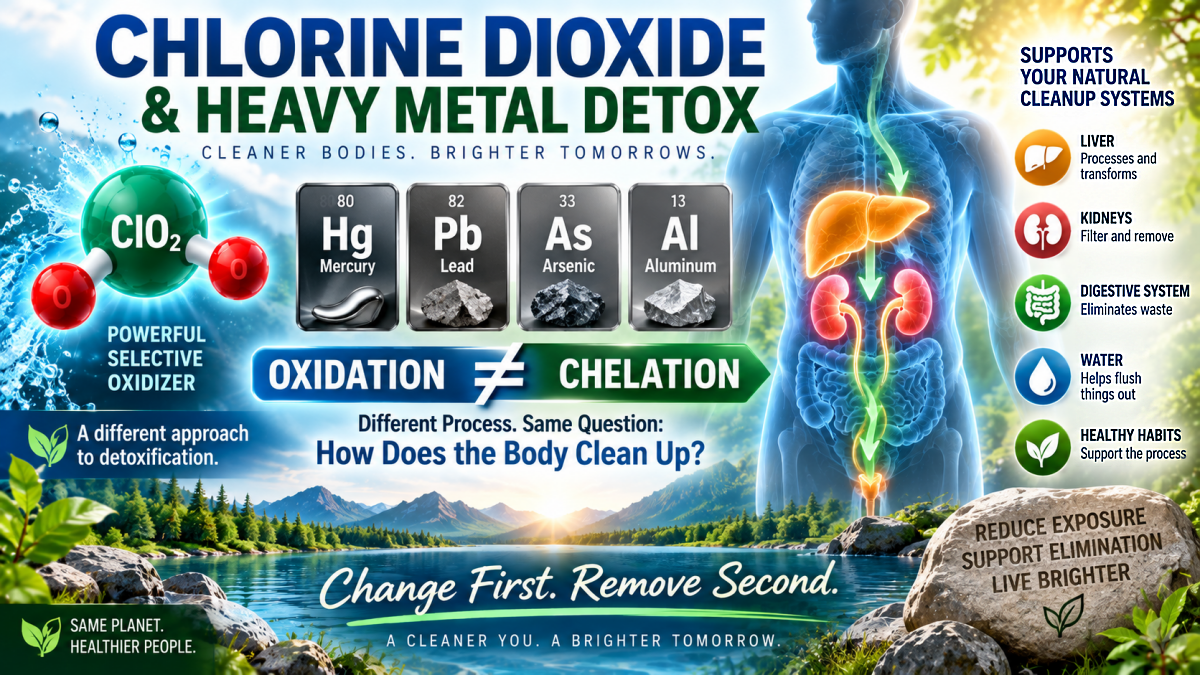
Chlorine Dioxide Is an Oxidizer

This is one of the most important things to understand about chlorine dioxide.

Chlorine dioxide is an oxidizer.

That means it can accept electrons from certain substances and change their chemistry.

This isn’t merely something chlorine dioxide enthusiasts say. Oxidation is the reason chlorine dioxide has become useful in water treatment and other applications. The EPA describes chlorine dioxide as a chemical oxidant, and scientific reviews describe its selective reactions with microorganisms, organic compounds and some inorganic substances.

Think of oxidation as changing something chemically rather than wrapping around it and carrying it away.

That is an important difference.

Chlorine Dioxide Is Not a Traditional Chelator

People sometimes call chlorine dioxide a chelator. Technically, that probably isn’t the best description. Traditional chelators such as EDTA or DMSA bind directly to certain metals. The resulting complex can then be removed from the body.

Chlorine dioxide’s basic chemistry is different. It reacts through oxidation. So when chlorine dioxide believers talk about “heavy-metal detox,” a better description may be: oxidative support for detoxification rather than conventional chelation.

That small distinction helps explain why chlorine dioxide doesn’t behave like an ordinary chelation product.

We Already Use Oxidation to Deal With Metals in Water

Here’s where the idea becomes easier to picture. Water-treatment specialists have long used oxidation to change contaminants into forms that are easier to manage.

Chlorine dioxide is used in water treatment for purposes including iron and manganese oxidation.

Researchers have also investigated chlorine dioxide for oxidizing arsenic in contaminated water. Arsenic can exist in different chemical forms. One important water-treatment strategy is changing arsenic from one oxidation state into another that can be more easily removed by later treatment processes. Researchers have specifically studied chlorine dioxide for this purpose.

That doesn’t prove the same thing happens inside the human body. But it helps explain why chlorine dioxide users became interested in the subject in the first place.

Chlorine dioxide changes chemistry through oxidation. And changing chemistry can sometimes change what happens next.
Chlorine Dioxide Kit

What Chlorine Dioxide Users Report

This is where practical experience enters the conversation. People using chlorine dioxide wellness protocols sometimes report changes they describe as “detox.”

They may describe:

  • clearer thinking
  • more energy
  • fewer headaches
  • improved sense of wellbeing
  • better digestion
  • changes in skin
  • temporary changes during their cleanup period

Some users believe these experiences result partly from reducing microorganisms, microbial waste, environmental contaminants, or accumulated substances that the body is trying to eliminate.

Heavy metals frequently appear in those discussions.

The important idea within this community is not necessarily that chlorine dioxide grabs a piece of mercury and carries it directly into the toilet.

The proposed picture is broader:

chlorine dioxide → oxidation → altered chemical environment → body’s normal detox systems → elimination

That’s considerably easier to understand.

Mercury

Mercury is probably one of the metals most commonly mentioned in detox conversations.

Possible exposure can come from several sources, depending upon the form of mercury involved.

Chlorine dioxide users report that they believe their wellness routines helped them deal with past mercury exposure. Rather than thinking of chlorine dioxide as a magnet that grabs mercury, they generally view chlorine dioxide as part of a larger oxidative cleanup process.

The body’s liver, kidneys, digestive system, and natural antioxidant systems would still have to do their jobs.

In other words: Chlorine dioxide isn’t the garbage truck.

It is thought of more as something that may help change the environment in which the cleanup takes place.

Lead

Lead is another metal people understandably want to avoid. Old paint, contaminated soil, some plumbing, and certain occupational exposures can all be sources.

The best heavy-metal strategy always begins with something wonderfully simple: Stop the exposure.

You don’t want to keep putting something into the body while simultaneously trying to get it out.

Once exposure has been identified and reduced, chlorine dioxide believers may include chlorine dioxide as one part of their broader cleanup program.

Again, the proposed role is oxidative rather than traditional chelation.

Arsenic Gives Us an Interesting Example

Arsenic is particularly interesting because chlorine dioxide has actually been studied for arsenic chemistry in water treatment.

Researchers have examined whether chlorine dioxide can oxidize arsenite, As(III), into arsenate, As(V). Changing the oxidation state can make arsenic easier for later water-treatment processes to remove.

Notice what chlorine dioxide isn’t doing. It isn’t magically making arsenic disappear. It is changing its chemistry. Then another process removes it.

That is a useful picture when thinking about the way chlorine dioxide enthusiasts approach detoxification:

Change first. Remove second.

Aluminum

Aluminum also comes up frequently in natural-health detox programs. People can encounter aluminum through food, water, occupational sources, and many everyday products.

Some chlorine dioxide users include aluminum among the substances they believe may become easier for the body to handle during a broader detoxification program.

This is another area where people sometimes combine chlorine dioxide with other wellness practices rather than expecting one product to accomplish everything.

Don’t Forget the Microbial Side

There is another possibility that makes this conversation interesting. What people call a “heavy-metal detox reaction” may not always involve metals alone.

Chlorine dioxide is widely used because of its antimicrobial properties. Its ability to inactivate microorganisms is well established in water treatment.

So someone using chlorine dioxide may believe several cleanup processes are happening at once:

  • microbial cleanup
  • changes in microbial waste
  • oxidation of reactive compounds
  • changes in the intestinal environment
  • normal liver and kidney elimination

and possibly

  • changes involving environmental contaminants

That makes the word detox much broader than simply removing mercury or lead.

Help the Body Finish the Job

One principle makes good sense, no matter which detox philosophy someone follows: The body still has to eliminate what it doesn’t need.

That means chlorine dioxide enthusiasts commonly pay attention to the basics as well.

  • Drink adequate water.
  • Eat nourishing foods.
  • Maintain normal bowel movements.
  • Get enough rest.
  • Move the body.
  • Reduce continuing exposure whenever possible.
  • Support good nutrition.

These aren’t glamorous ideas. But detoxification isn’t only about what you put into the body. It’s also about keeping the body’s normal exits working.

Don’t Confuse Chlorine Dioxide With Chlorine

This is worth repeating because the names sound similar. Chlorine dioxide is not the same substance as household chlorine bleach. Chlorine dioxide has its own chemistry and its own uses.

In water, chlorine dioxide reacts and produces substances including chlorite and chlorate. That’s one reason concentration and proper preparation matter. More isn’t automatically better.

Heavy Metals Can Be Measured

Here’s something especially useful about this subject. Heavy-metal exposure doesn’t have to remain a guessing game. When someone seriously suspects lead, mercury, arsenic, or another toxic-metal exposure, appropriate testing can sometimes establish whether an unusual exposure actually exists.

That gives the chlorine dioxide community an interesting opportunity.

Instead of relying only on: “I felt much better after detoxing,” we can also ask: “What did the measurements show?”

That could make future observations much more useful.

Chlorine Dioxide for Humans

A Simple Way to Think About It

Traditional chelation and chlorine dioxide shouldn’t be thought of as the same thing. A traditional chelator is more like a substance designed to grab onto a metal.

Chlorine dioxide is an oxidizer. Its specialty is changing chemistry.

That gives us a simple picture:

EXPOSURE

↓

REDUCE THE SOURCE

↓

OXIDATIVE CLEANUP

↓

SUPPORT THE BODY

↓

NORMAL ELIMINATION

For chlorine dioxide users, that is the heart of the heavy-metal detox idea.

Cleanup Is a Process

There probably isn’t one magic substance that handles everything the body encounters. That’s why many experienced natural-health practitioners think in terms of creating a healthier environment rather than chasing one toxin at a time.

  • Reduce what shouldn’t be coming in.
  • Give the body what it needs.
  • Keep the normal elimination pathways moving.
  • And allow time for cleanup.

Chlorine dioxide enthusiasts believe its unusual oxidative chemistry may give it a useful place in that process.

Perhaps the simplest way to say it is:

Chlorine dioxide doesn’t need to be a traditional chelator to be interesting in a detox program. Its specialty is oxidation, changing the chemical environment so the body’s own cleanup systems can do what they were designed to do.

And for people exploring heavy-metal detoxification, that makes chlorine dioxide one more interesting tool in the cleanup toolbox.

A Practical Note

Known or suspected heavy-metal poisoning—especially lead, mercury, or arsenic poisoning—is different from a general wellness “detox.” Significant exposure can cause permanent injury and can be measured and medically treated. Chlorine dioxide should not replace appropriate testing or treatment for confirmed poisoning.

 

Categories
Chlorine Dioxide

Chlorine Dioxide, Microbes, Disease n Cancer: What Do We Know?

From microbes to cancer cells, researchers are asking some unusual questions. For most people, chlorine dioxide belongs in one category: Water purification. It is an oxidizing agent with powerful antimicrobial properties, which is precisely why it has been used in water treatment, sanitation, and other disinfection applications.

But an unusual scientific question has been emerging around chlorine dioxide. What happens when its oxidative chemistry encounters something other than contaminated water?

That question becomes particularly interesting when we look at two recent reports involving people with advanced cancer. They certainly don’t prove that chlorine dioxide treats cancer. But they do make it considerably harder to say there is nothing here worth investigating.

First, Something Important About Oxidation

The word oxidation can sound intimidating. But oxidation is happening throughout nature, and throughout the human body, all the time.

Our immune systems even use reactive oxygen chemistry as part of their defense against invading microorganisms. Chlorine dioxide is also an oxidizing agent.

Its ability to damage microorganisms is well established, and research has examined its antimicrobial action against bacteria, viruses, and other microbes.

That naturally raises another question:

Could its oxidative activity interact differently with unhealthy cells than with healthy biological systems?

That question is far from settled. But researchers have begun asking it.

The 2023 Cancer Case Series

In 2023, researchers Manuel Aparicio-Alonso, Laurent Schwartz, and Verónica Torres-Solórzano reported a small case series involving chlorine dioxide solution and metastatic cancer.

Three patients in the later version of the report had metastatic kidney cancer, prostate cancer, and lymphoma.

The researchers reported lasting tumor responses following treatment incorporating chlorine dioxide solution and stated that they observed no associated side effects in those cases. Importantly, these weren’t randomized patients receiving chlorine dioxide versus a placebo. They were compassionate-use cases involving people who had declined conventional chemotherapy, radiation, or immunotherapy.

The authors proposed that chlorine dioxide’s oxidative chemistry might disturb the redox balance of cancer cells. “Redox balance” sounds complicated. The basic idea isn’t.

Cells Have to Keep Their Chemistry Balanced

Think about a campfire. A little oxygen helps keep it burning. Too much under the wrong circumstances can dramatically change what happens.

Cells also maintain carefully controlled chemical balances.

Cancer cells aren’t simply normal cells growing faster. Their metabolism can be substantially altered, and researchers have long investigated whether those differences create vulnerabilities that treatments might exploit.

The 2023 authors wondered whether oxidative chemistry could represent one of those vulnerabilities.

They concluded not that the question was settled, but that controlled clinical studies were warranted.

That is a very important distinction.

Then Came the 2024 Prostate Cancer Report

The following year brought something more detailed. Aparicio-Alonso and Torres-Solórzano published a case report concerning a man with metastatic prostate cancer.

The authors reported tumor reduction at sites distant from the original tumor and stated that they observed no side effects associated with their experimental chlorine-dioxide-based intervention.

Their proposed explanation again centered on oxidative balance. And once again, the authors themselves emphasized the limitation:

rigorous clinical trials are needed.

The paper was published in Salud, Ciencia y Tecnología in 2024 and includes a DOI and a reference list discussing chlorine dioxide, reactive oxygen species, toxicology, tumor metabolism, and related subjects.

Read the 2024 published case report

Two Reports Are Not a Cancer Treatment

This deserves its own heading because it is so important. A three-person case series and a single case report cannot establish that chlorine dioxide treats cancer. There was no large randomized control group. There was no blinding.

The patients weren’t necessarily receiving chlorine dioxide as their only intervention. Dietary and metabolic interventions were also involved in at least some cases. The 2023 report, for example, mentions intermittent fasting and a ketogenic diet.

Therefore, these reports cannot tell us which intervention, or combination of interventions, was responsible for the outcomes. But that doesn’t make the observations scientifically meaningless.

It means they are hypothesis-generating. They give researchers something to test.

And That’s Where the Story Gets Bigger

Cancer isn’t the only reason people have become interested in chlorine dioxide. Its established antimicrobial activity has led some researchers and natural-health practitioners to wonder whether microbial involvement might help explain anecdotal reports concerning apparently unrelated health problems.

That idea needs careful handling because microorganisms have very different relationships with different diseases. Some connections are well established. Others are suspected. Still others remain speculative.

But the general principle, that infection can sometimes produce effects far beyond the site of infection, isn’t controversial.

Microbes and their products can interact with inflammation, immunity, metabolism, and other biological systems. That creates a fascinating research landscape.

The Long List of Questions

This is where reports surrounding chlorine dioxide become particularly intriguing.

Chlorine dioxide advocates have discussed improvements involving conditions as diverse as:

Neurological and cognitive concerns

  • Alzheimer’s disease and dementia
  • multiple sclerosis
  • brain fog and cognitive difficulties
  • neurological symptoms

Cancer

  • prostate cancer
  • kidney cancer
  • lymphoma
  • other metastatic cancers

Infectious diseases

  • malaria
  • microbial and fungal infections
  • parasitic infections

Immune-related conditions

  • chronic illness
  • persistent inflammatory complaints
  • immune dysfunction

Energy and systemic complaints

  • chronic fatigue
  • unexplained fatigue
  • environmental sensitivities
  • general decline

Sexual and reproductive concerns

  • sexual dysfunction
  • certain reproductive complaints

Not every condition on this list is caused by microorganisms.

And evidence that chlorine dioxide can destroy a microorganism outside the body does not establish that drinking chlorine dioxide will cure a disease caused by that microorganism.

But the diversity of the reports raises an intriguing alternative question:

Could some apparently unrelated conditions occasionally share biological pathways that we haven’t adequately investigated?

That is a much more scientifically useful question.

What About “Toxins”?

This is another area where terminology matters. Microorganisms can produce biologically active substances.

Fungi, for example, can produce mycotoxins. Bacteria can produce other toxins and metabolic products. Some of these substances can cause significant illness. But it would be misleading to describe all microbial waste as mycotoxins or to assume that simply oxidizing these substances inside the body necessarily eliminates a disease.

That’s a hypothesis requiring evidence. The interesting part is that oxidation can chemically modify molecules.

So the appropriate scientific question isn’t: “Does chlorine dioxide detox everything?”

It’s: “Which biologically relevant molecules does chlorine dioxide react with, at what concentrations, and what happens afterward?”

Suddenly, we have an experiment instead of an argument.

What About Heavy Metals?

Mercury, lead, and certain other metals can unquestionably damage the nervous system at sufficient exposure levels. But that is a different problem from microbial infection. And chlorine dioxide shouldn’t be casually presented as a heavy-metal detoxification treatment.

If someone has suspected heavy-metal poisoning, identifying the metal, measuring exposure appropriately, removing the source, and obtaining proper medical treatment are important.

Again, separating different mechanisms makes the chlorine dioxide discussion stronger rather than weaker.

And DMSO?

DMSO frequently appears in alternative-health discussions because it readily penetrates biological tissues and can alter the movement of other substances.

That property is precisely why combining it casually with a strong oxidizer deserves caution.

The 2024 chlorine dioxide case report does discuss DMSO as part of its intervention, and its references include toxicological literature concerning DMSO.

That makes the combination a legitimate subject for research. It does not establish a safe do-it-yourself protocol for tumors, toenail fungus, or cancer. Those are two very different conclusions.

Chlorine Dioxide Is Not “Stabilized Oxygen”

There’s also an old terminology problem worth cleaning up. Sodium chlorite, chlorine dioxide, and oxygen are different chemical substances.

Sodium chlorite can be used as a precursor for generating chlorine dioxide, but calling sodium chlorite “stabilized oxygen” can create the impression that someone is simply consuming a special form of oxygen. Chemically, that isn’t accurate.

Likewise, sodium chlorite should not be confused with sodium chloride, ordinary table salt. One letter makes a substantial chemical difference.

Maybe the Most Interesting Question Isn’t “Does It Work?”

This is where the chlorine dioxide conversation often goes wrong.

One side says: “It cures everything.”

Another says: “There’s nothing worth investigating.”

Neither position is particularly useful for discovery. The better questions are narrower.

  • What does chlorine dioxide actually react with inside biological systems?
  • Are certain microorganisms more susceptible than others?
  • Are particular abnormal cells unusually vulnerable to oxidative disruption?
  • Can concentrations that affect a target avoid unacceptable injury to healthy tissue?
  • Do the observations reported in cancer case studies survive randomized controlled testing?
  • And could any of this help explain the extraordinary range of anecdotal observations that have accumulated around chlorine dioxide?

Those are research questions. And research questions can be answered.

Follow the Observation

The 2024 prostate cancer researchers cited previous work reporting both anticancer and antiviral activity associated with chlorine-dioxide-induced reactive oxygen species. Their own report nevertheless concludes by emphasizing that rigorous trials are necessary before its preliminary observation can be validated.

That’s probably exactly where this subject belongs today.

Not: “We know chlorine dioxide cures cancer.” We don’t.

And not: “There couldn’t possibly be anything here.” The available observations don’t justify that certainty either.

Instead: Something unusual has been observed. A mechanism has been proposed. Preliminary cases have been documented. Now test it properly.

That is how science is supposed to move forward.

Perhaps larger controlled studies will show that the apparent responses had other explanations. Perhaps researchers will discover an effect, but only under very specific circumstances. Or perhaps chlorine dioxide’s oxidative chemistry will reveal something entirely unexpected.

Nobody should have to know the answer before asking the question.

Educational Notice

This article is for informational and research purposes only and does not recommend chlorine dioxide, sodium chlorite, DMSO, fasting, dietary interventions, “liver flushes,” or detoxification regimens for cancer or other diseases. The studies discussed are preliminary case reports/case series and do not establish chlorine dioxide as a safe or effective cancer treatment. People undergoing cancer treatment should not replace or delay established medical care based on these reports. Chlorine dioxide is a reactive oxidizing chemical, and route, concentration, formulation, and exposure substantially affect risk.


Categories
Chlorine Dioxide

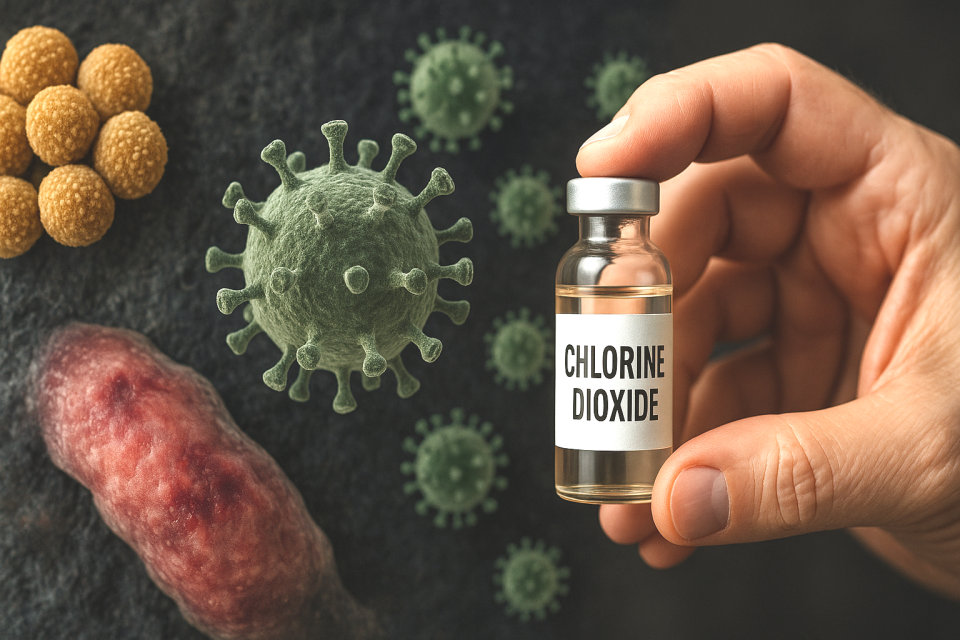
Creepy Crawlies Out of Control: Chlorine Dioxide and Viruses

In a world where antibiotic-resistant bacteria, deadly viruses, and “superbugs” are evolving faster than modern medicine can keep up, many are left wondering: What happens when the drugs stop working? Diseases like MRSA (methicillin-resistant Staphylococcus aureus), staph infections, flesh-eating bacteria, and even persistent variants of COVID-19 are not just headlines—they’re rapidly growing public health threats. Yet amid the fear and frustration, a controversial yet compelling candidate has quietly entered the conversation: chlorine dioxide (ClO₂).

Staph infections, especially those caused by MRSA, have exploded in both hospital and community settings. These bacteria have evolved to resist almost every class of antibiotics. In the U.S. and Europe, MRSA is responsible for at least 50,000 deaths per year. In some countries, MRSA is responsible for nearly 50% of all Staphylococcus aureus bloodstream infections.

The growing threat isn’t just limited to bacteria. Mutating viruses, such as emerging COVID-19 variants and viral hemorrhagic fevers, are challenging vaccine effectiveness and pharmaceutical solutions.

So, what if the solution wasn’t another synthetic drug, but rather a simple oxidative molecule that’s been around for over 200 years?

From Industrial Disinfectant to Biomedical Breakthrough

Once dismissed as mere “bleach” by its critics, chlorine dioxide (ClO₂) has proven itself much more than a cleaning agent. Used widely in water treatment, food sanitation, and hospital disinfection, this molecule is now under the microscope as an alternative supplement with broad-spectrum antimicrobial power.

A recent peer-reviewed study published in the Journal of Bacteriology & Mycology: Open Access highlights chlorine dioxide’s exceptional ability to neutralize MRSA, one of the most infamous and deadly bacterial strains plaguing healthcare systems today.

Key Findings from the Study:

  • Conducted by Dr. George Georgiou of the Da Vinci BioSciences Research Centre in Cyprus.
  • MRSA exposed to chlorine dioxide at concentrations as low as 0.5 ppm showed 99.99% inhibition of growth.
  • All concentrations tested, ranging from 0.5 ppm to 5 ppm, for durations from 30 seconds to 30 minutes, effectively eradicated MRSA colonies in vitro.

“In these in vitro experiments, the efficacy of chlorine dioxide against MRSA has been shown consistently, with growth inhibition of 99.99% – 100% in even the smallest concentrations,” wrote Dr. Georgiou.

Why Does Chlorine Dioxide Work So Well?

Chlorine dioxide works as an oxidizer, meaning it disrupts the cell walls and internal structures of pathogens via oxygen release, without harming healthy tissues. Unlike antibiotics, which poison bacteria in specific ways (often easily resisted), ClO₂ kills by oxidation, a method microbes have a much harder time adapting to.

It also penetrates biofilms, the slimy protective layers that microbes form to shield themselves from drugs and immune responses, something antibiotics often fail to breach.

A Track Record Beyond MRSA

Chlorine dioxide’s antimicrobial spectrum doesn’t stop at staph infections:

  • Malaria: Anecdotal reports and field trials (especially in Africa and Latin America) suggest rapid reversal of malaria symptoms following ClO₂ administration.
  • HIV: Experimental and anecdotal evidence indicate reduced viral load in HIV-positive individuals, though formal clinical trials are still needed.
  • COVID-19: Some independent physicians and researchers have observed promising outcomes with ClO₂ protocols, though these remain under intense scrutiny.

In one study, chlorine dioxide was shown to inactivate 99.9% of viruses within 15 seconds at concentrations ranging from 1 to 100 ppm, demonstrating its rapid effectiveness against even the most stubborn viral agents.

2-part chlorine dioxide kit

Despite these promising outcomes, mainstream medicine and public health agencies continue to condemn chlorine dioxide as unsafe for internal use. Their basis? Primarily, it’s classification as an “industrial disinfectant.”

Yet, millions of people around the world, many of them desperate and without access to traditional healthcare, report improved health outcomes from ClO₂ protocols, especially when pharmaceuticals have failed or aren’t available. And importantly, independent researchers like Dr. Georgiou are not financially backed by pharmaceutical companies, which allows them to pursue their studies without conflict of interest, but also without institutional protection.

The science is compelling. The testimonials are overwhelming. The resistance from regulatory bodies is intense.

It is time to demand high-quality, unbiased clinical trials that explore the therapeutic use of chlorine dioxide in fighting today’s most dangerous pathogens. With proper dosing, oversight, and scientific inquiry, chlorine dioxide may become not just a treatment but a revolutionary medical tool, capable of challenging the supremacy of antibiotics and synthetic antivirals.

Ready to Use CDS

Chlorine Dioxide: A Simple Solution to Complex Problems

In a world overrun with invisible invaders, drug-resistant bacteria, evolving viruses, and mutating pathogens, humanity may need to look to the past to move forward.

A humble molecule first discovered in 1811 by Sir Humphry Davy, chlorine dioxide could prove to be one of the most powerful disease-fighting tools of the modern age. Whether accepted or denied by mainstream science, the growing evidence cannot be ignored.

And while skepticism is healthy, suppression is not. Especially when lives are on the line and superbugs continue to gain ground.

Chlorine Dioxide for Humans Book

Sources & Further Reading:

  • Georgiou, G. (2024). The Efficacy of Chlorine Dioxide Against MRSA In Vitro. Journal of Bacteriology & Mycology: Open Access. [Available online]
  • Ogata, N. & Shibata, T. (2008). Protective effect of low-concentration chlorine dioxide gas against influenza virus infection. Journal of General Virology.
  • University of Almería (2020). Toxicology Evaluation of Chlorine Dioxide in Animal Models.
  • Kálcker, A. L. (2021). Forbidden Health: The Hidden Power of Chlorine Dioxide.
  • Humble, Paris (2022). Healthy Alternative Chlorine Dioxide Uses: Non-pharmalogical health restoration.
  • Independent researcher archives and anecdotal case studies (See: MMS, Genesis II Church records, field trials in Africa and Latin America)