How New Information Changes What We Think We Know About Chlorine Dioxide—and Everything Else
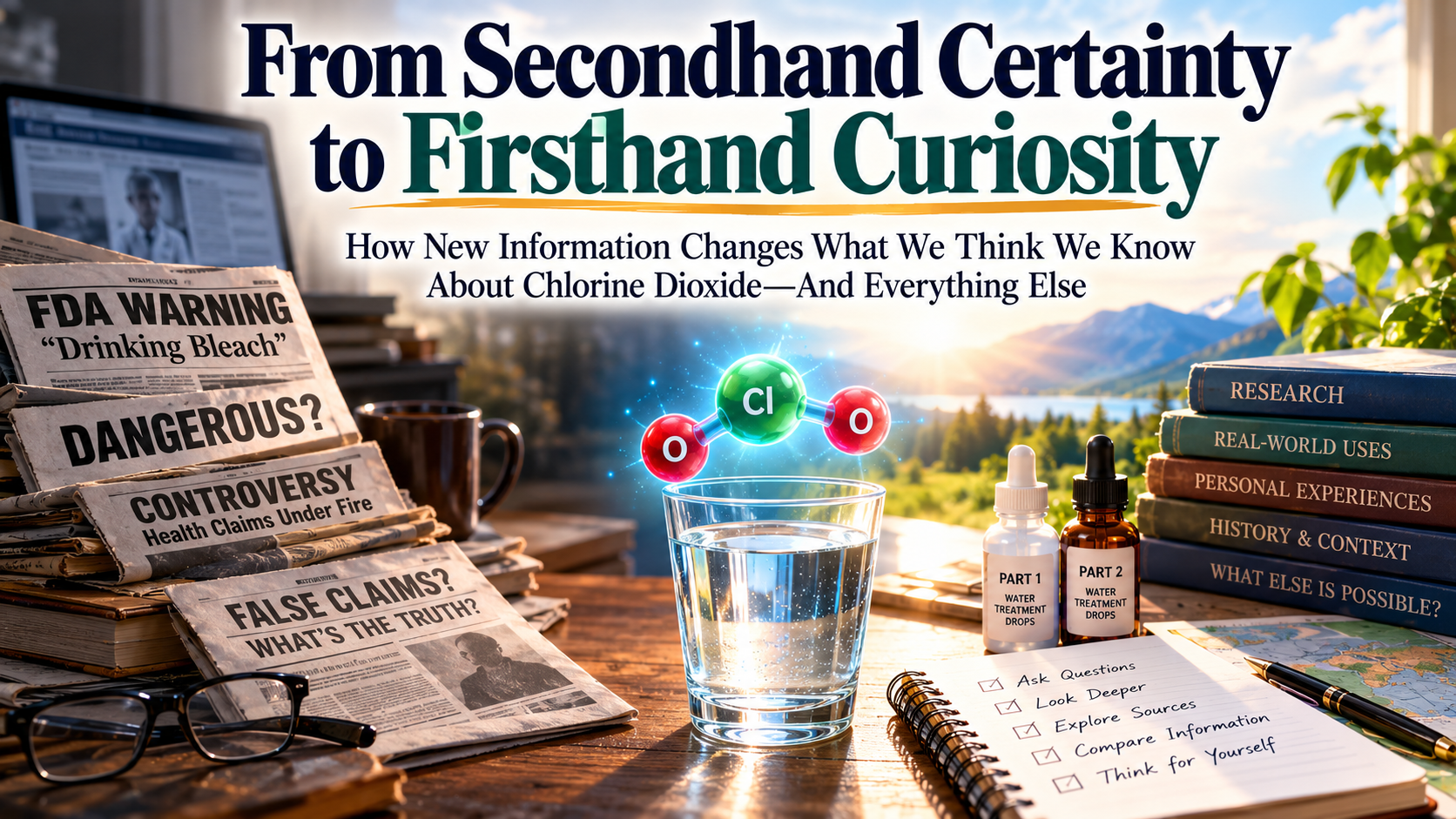
A conversation about chlorine dioxide recently produced an unusually revealing observation. A man who had once been openly skeptical of the substance described how his opinion had changed after exploring it for himself. “I used to be a regurgitator,” he explained. “Then I became an experimenter.”
His choice of words was blunt, perhaps unnecessarily so. But the experience he was describing is remarkably familiar. He had accepted what he’d heard about chlorine dioxide, repeated those conclusions, and considered the subject settled.
Then he encountered information and experiences that challenged his previous understanding. Today, he describes himself as a believer.
The interesting part of his story isn’t necessarily the conclusion he reached. It’s the process that led him there.
Something he once considered settled became something worth reconsidering.
And that experience extends far beyond chlorine dioxide.
Most of What People Know Comes from Someone Else
Human beings depend on information passed from one person to another. Scientific discoveries, medical knowledge, historical accounts, technological advances, and everyday practical wisdom are all shared through generations of learning.
Nobody has the time or resources to independently verify everything they believe. Instead, people rely on trusted sources.
They learn from teachers, physicians, researchers, family members, books, news organizations, and personal relationships.
This is not a weakness. It’s one of the foundations of civilization. But there’s an important difference between relying on established knowledge and developing an unquestioned certainty about something that has never been personally examined.
Sometimes a familiar explanation becomes so widely repeated that people forget where it originated.
A statement becomes conventional wisdom. An opinion becomes an assumption. Eventually, the assumption becomes something people no longer question.
This phenomenon might be called secondhand certainty. It isn’t necessarily incorrect. It simply describes confidence that has been inherited rather than personally developed. And nearly everyone carries some of it.
Chlorine Dioxide: A Curious Example
Chlorine dioxide offers an interesting illustration of how secondhand certainty develops.
Ask different people what they know about chlorine dioxide, and the answers may vary dramatically.
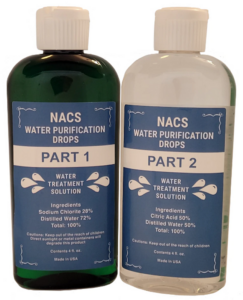
Some recognize it as a disinfectant used in water treatment. Others associate it with industrial sanitation, food-processing applications, or municipal drinking-water systems. Still others immediately associate it with controversial health claims and the phrase “drinking bleach.”
Each person may be drawing from a different body of information. And each may believe they understand the subject.
Chlorine dioxide is a real chemical compound with established oxidizing and antimicrobial properties. It has recognized applications in controlled water treatment and disinfection. It has also been promoted for unconventional health purposes, leading to considerable controversy over its safety and the claims made about it.
These are different aspects of the same subject. Yet public discussions frequently compress them into a single judgment.
For some, chlorine dioxide represents an intriguing substance with applications worth understanding. For others, it is primarily associated with irresponsible medical claims.
The chemistry, however, does not change according to which narrative a person encounters first. And neither does the value of understanding the distinctions.
When Familiar Explanations Stop Being Enough
The man who described his transition from skeptic to believer was not necessarily persuaded by a better argument. His account suggests something more personal. He encountered experiences that caused him to question his previous assumptions.
What had once seemed obvious no longer seemed complete. This is a common turning point in human understanding.
Someone encounters information that doesn’t fit an existing belief.
At first, the information may be dismissed. Then curiosity begins to develop. Perhaps there is another explanation. Perhaps something important has been overlooked. Perhaps the original understanding was accurate in some respects but incomplete in others.
The person begins exploring. And sometimes, the exploration changes their perspective. The outcome isn’t always a reversal of belief. Sometimes it produces a more nuanced understanding.
The experience can be transformative because it changes the person’s relationship with certainty.
Instead of asking only whether new information agrees with an existing belief, they begin asking what the new information might reveal.
The Difference Between Knowing and Repeating
Repetition is one of the ways information becomes familiar. It is also one of the ways misinformation can spread.
A statement appears in an article. Someone repeats it in conversation. Another person shares it online. Soon, the statement appears in multiple places, creating the impression that it has been independently confirmed.
But repetition alone does not establish accuracy.
The same phenomenon can occur with accurate information, incomplete explanations, exaggerated claims, and mistaken assumptions.
Over time, the original context may disappear.
A careful qualification becomes a sweeping conclusion. A possibility becomes a certainty. Or an observation becomes an explanation that was never established.
This is not unique to controversial health subjects. It happens in business, education, politics, relationships, nutrition, and everyday life.
People routinely inherit beliefs about what works, what doesn’t, what’s possible, and what should be avoided. Most of those beliefs remain unexamined until something challenges them. And sometimes, the challenge begins with a surprisingly simple discovery.
Chlorine Dioxide Has More Than One Story
The public history of chlorine dioxide illustrates how competing narratives can shape understanding. Its established industrial and water-treatment applications are based on measurable chemical properties and defined operating conditions. Its alternative-health history developed differently.
Early advocates described personal experiences and reported improvements involving a wide range of health concerns. Some became convinced they had encountered something extraordinary. Others attempted to explain those experiences through theories that extended beyond established scientific knowledge. Enthusiasm sometimes outpaced understanding.
Regulatory agencies, meanwhile, issued warnings about consuming chlorine dioxide preparations promoted as treatments for disease. Those warnings addressed genuine health risks. But the resulting public controversy also encouraged a tendency to treat the subject as a contest between opposing camps.
Advocates defended their experiences. Critics emphasized unsupported claims and potential harm. Media coverage frequently favored the most dramatic elements of the dispute. And people encountering the subject for the first time often received a simplified version of a considerably more complicated history.
The result was an environment in which opinions could become entrenched before the underlying distinctions were fully understood.
This doesn’t mean that every perspective carries equal scientific weight. It means that understanding a controversial subject requires knowing which questions are being answered, and which are not.
The Power of New Information
New information doesn’t always change the facts. Sometimes it changes what people notice.
Consider someone learning an unfamiliar word. After discovering its meaning, they suddenly begin noticing it in conversations, books, and advertisements. The word was probably present before. But now it has become recognizable.
A similar experience occurs when people encounter new information about a familiar subject.
- Someone learns that a substance associated with one application has several others.
- Someone discovers that a historical event was more complicated than the version they learned in school.
- Someone meets a person whose experiences contradict a long-held stereotype.
- Someone encounters research that adds detail to an explanation they previously considered complete.
The new information changes the way the subject is perceived.
It may not overturn everything previously understood. But it can reveal that the original explanation was only part of the story.
Once people discover that a familiar story has missing chapters, they may become interested in reading the rest.
When Science Adds Another Chapter
Scientific knowledge develops through continuing discovery.
Researchers refine explanations, identify previously unknown properties, and investigate new applications of familiar substances.
Sometimes promising ideas prove less useful than expected. Sometimes established technologies find applications that were not originally anticipated. And sometimes new findings challenge assumptions that had remained unquestioned for years.
Chlorine dioxide has a substantial history in disinfection and water treatment, and research continues into particular applications involving microorganisms, surfaces, and other controlled environments.
These developments contribute to a more detailed understanding of its chemical behavior and practical uses. They do not automatically validate unrelated medical claims. But they illustrate why scientific understanding should be considered an evolving body of knowledge rather than a collection of slogans.
A substance can have (1) established applications, (2) recognized hazards, (3) unanswered questions, and (4) emerging areas of investigation simultaneously. There is no contradiction in acknowledging all four.
The Freedom to Say, “I Didn’t Know That”
Modern public conversations often reward certainty. People are encouraged to take positions, defend them, and demonstrate confidence.
Changing one’s mind can be interpreted as inconsistency. Admitting uncertainty can feel uncomfortable. And acknowledging that someone else has introduced unfamiliar information may seem like surrendering an argument.
But learning doesn’t have to be an argument. Sometimes the most useful response is simply:
“I didn’t know that.”
Those four words leave room for discovery. They don’t require immediate agreement. They don’t demand that a person abandon everything previously understood. They simply acknowledge that something new has entered the conversation.
That willingness is especially valuable when discussing subjects surrounded by strong opinions.
A person can respect established knowledge while remaining open to additional information. They can listen to an unusual experience without immediately adopting its proposed explanation. And they can discover that a familiar belief needs refinement without treating the discovery as a personal defeat.
From Skeptic to Believer—or Something Else?
The man whose observation opened this discussion described becoming a chlorine dioxide believer after exploring the subject personally. His experience changed his perspective.
The broader lesson doesn’t depend on everyone reaching the same conclusion.
Another person might investigate chlorine dioxide and become more skeptical of certain claims. Someone else might discover legitimate applications they previously knew nothing about. A third might develop a more nuanced view that recognizes both the compound’s established properties and the limitations of particular claims.
Each person may emerge with a different understanding.
What matters is the willingness to examine information rather than simply repeat a position.
There is a difference between replacing one unquestioned belief with another and developing a deeper understanding of a subject.
The latter leaves room for continued learning. That is where firsthand curiosity becomes particularly valuable.
What Else Do People Think They Know?
The implications extend well beyond chlorine dioxide.
- How many beliefs are inherited without much consideration?
- How many familiar explanations have become accepted simply because they’ve been repeated for years?
- How often does new information reveal that something previously considered straightforward is actually more complicated?
These questions need not encourage suspicion of everything. Reliable knowledge, scientific expertise, and trusted institutions remain essential.
Trust and curiosity are not opposites. People can respect expertise without assuming that every explanation is complete. They can appreciate personal experiences without treating them as universal conclusions. And they can recognize the value of established understanding while remaining interested in what may be discovered next.
The goal is not to question everything endlessly. It is to remain capable of learning something new.
From Secondhand Certainty to Firsthand Curiosity
A man who once repeated what he’d heard about chlorine dioxide eventually encountered experiences that changed his opinion. He now describes himself as a believer. Others may interpret the same subject differently. But his story illustrates something nearly universal.
Human understanding changes when new information enters the picture. Sometimes the change is dramatic. Sometimes it’s subtle. Sometimes an old belief is replaced. And sometimes it simply becomes more complete.
The most interesting moment may not be when someone announces a new conviction. It may be the quieter moment that comes before it. The moment when certainty gives way to curiosity.
When a familiar explanation no longer seems quite sufficient. When someone encounters something unexpected and responds: “I didn’t know that.”
Those words are not an admission of foolishness. They are an acknowledgment that learning is still possible. And perhaps that’s the most valuable lesson in the entire conversation.
Changing your mind doesn’t necessarily mean you were foolish before. Sometimes it simply means you know something today that you didn’t know yesterday.
Disclaimer: This article explores changing beliefs, personal experiences, and public perceptions surrounding chlorine dioxide. Chlorine dioxide has established uses in controlled disinfection and water treatment, but these applications do not establish its safety or effectiveness as a medical treatment. Ingesting chlorine dioxide preparations for health purposes can cause serious harm. Personal experiences and emerging research should be understood within their appropriate contexts.