In March 2016, two Chinese inventors filed a pharmaceutical patent describing an unusual approach to cancer research. Rather than investigating chlorine dioxide primarily as a disinfectant, they proposed using specially prepared chlorine dioxide formulations to influence tumor growth and potentially stimulate an immune response against cancer cells elsewhere in the body.
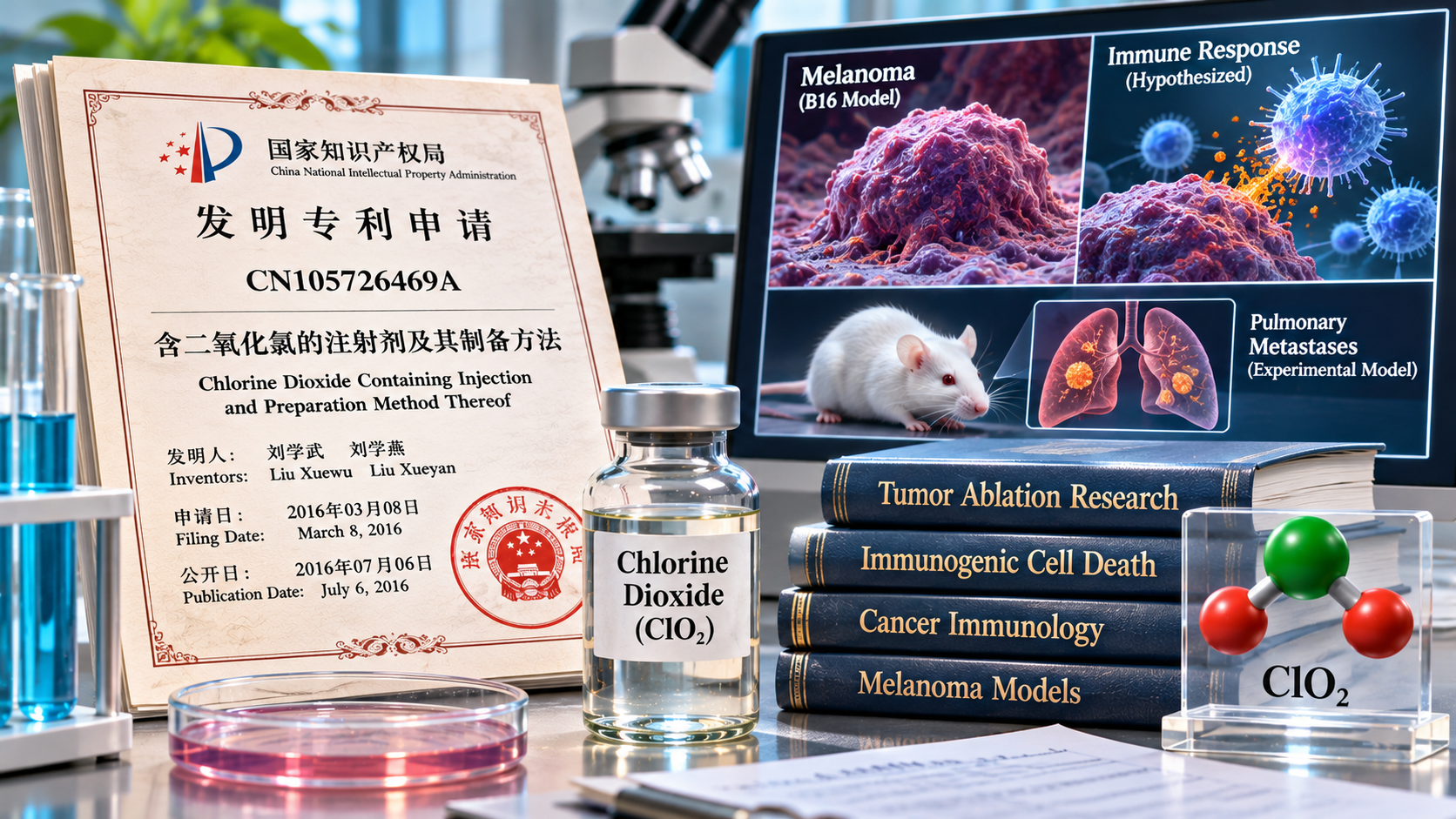
The invention was accompanied by several reported animal experiments. Some examined the toxicity of different chlorine dioxide preparations. Others investigated tumor growth in mice implanted with melanoma cells. A further experiment explored whether treatment of one tumor could influence metastatic disease in the lungs.
The patent’s central hypothesis was that local tumor destruction might trigger a broader immune response capable of affecting cancer cells beyond the original treatment site.
This concept resembles an established area of cancer research involving immunogenic cell death, in which dying tumor cells can stimulate immune recognition under certain circumstances.
The inventors’ particular application of that concept to chlorine dioxide was experimental and has not been established as an effective cancer treatment in humans.
Nevertheless, the patent provides a detailed historical record of how the researchers developed their hypothesis, what they reported observing in mice, and which questions remain unanswered.
The Chinese Patent and Its Inventors
The principal document is:
CN105726469A: Chlorine Dioxide Containing Injection and Preparation Method Thereof
The patent identifies two inventors:
Liu Xuewu (刘学武) and Liu Xueyan (刘学燕).
Its recorded history includes:
| Event | Date |
| Chinese priority and filing | March 8, 2016 |
| Chinese application published | July 6, 2016 |
| International application filed | January 18, 2017 |
| International application published | September 14, 2017 |
The invention subsequently appeared in international and American patent filings.
The international publication is:
WO2017152718A1: Injection Comprising Chlorine Dioxide and Preparation Method Therefor
The corresponding American application is:
US20190015445A1: Injection Comprising Chlorine Dioxide and Preparation Method Therefor
These publications belong to the same invention family. Their appearance in different patent jurisdictions does not represent independent replication of the experiments.
The international application is recorded as ceased in the patent database. The original Chinese application is listed as pending, although current legal status requires confirmation through the relevant patent offices.
The Inventors’ Central Research Question
The patent begins with a formulation problem.
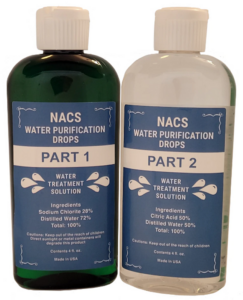
Chlorine dioxide is a reactive chemical that can be generated through different processes. Some preparations contain residual chemical precursors, acids, salts, and other reaction products.
The inventors argued that these accompanying substances might influence the biological effects of a formulation.
They proposed separating chlorine dioxide from reaction byproducts before incorporating it into a pharmaceutical carrier.
Their objective was to produce preparations with different chemical characteristics from solutions obtained by simply mixing chlorine dioxide precursors and acids.
The researchers also investigated whether the resulting preparations could be maintained at relatively high concentrations under controlled storage conditions.
The significance of this distinction became particularly apparent in their animal toxicity experiments.
The First Animal Experiment: Comparing Toxicity
One of the patent’s most informative sections describes a toxicity comparison involving three chlorine dioxide preparations.
The inventors used Kunming mice and examined the effects of repeated subcutaneous exposure.
The three preparations differed in their manufacturing characteristics.
Preparation A was produced by mixing chlorine dioxide precursors with acid. The resulting solution contained reaction products and had an acidic pH.
Preparation B used a related preparation approach, but its pH was adjusted toward neutrality.
Preparation C was the inventors’ proposed purified formulation, produced through a different process and incorporated into a saline-based carrier.
The patent reports that the first two preparations caused substantial mortality in the experimental animals.
For Preparation A, the inventors described multiple deaths occurring during the first two days.
Preparation B also produced substantial mortality, despite the pH adjustment.
By contrast, the inventors reported no deaths during the seven-day observation period among the mice receiving Preparation C.
What Can Be Concluded?
The observations suggest that the preparations behaved differently in this particular animal experiment.
The inventors interpreted the results as evidence that chemical impurities and formulation acidity contributed substantially to toxicity.
That interpretation is plausible as a research hypothesis, but the experiment does not isolate every possible cause.
The preparations differed in more than one characteristic, including chemical composition and concentration.
The absence of deaths in one experimental group during a short observation period also does not establish that the formulation was harmless.
A comprehensive toxicity investigation would require examination of tissue injury, blood chemistry, organ function, longer-term outcomes, and possible delayed effects.
The important finding is that the patent reports a striking difference in acute mortality among the tested preparations.
The exact chemical reasons for that difference would require additional analytical and biological investigation.
The Second Experiment: Melanoma Tumor Growth in Mice
The researchers next examined whether the proposed chlorine dioxide formulations affected tumor growth.
They used C57 mice implanted with B16 melanoma cells.
B16 melanoma is a widely used experimental mouse cancer model.
It allows researchers to investigate tumor growth, immune responses, and metastatic behavior under controlled conditions.
The patent describes dividing the animals into four groups, with ten mice assigned to each group.
Three groups received different chlorine dioxide preparations delivered directly into the experimental tumors.
The fourth group received saline and served as the comparison group.
The investigators monitored tumor development over a 20-day experimental period.
At the conclusion of the experiment, they removed and weighed the tumors.
Reported Observations
The inventors reported that tumor inhibition increased with the concentration of chlorine dioxide in the tested preparations.
They described a stronger inhibitory effect among mice receiving the more concentrated formulations.
The patent presents the findings as evidence of a concentration-dependent response.
Its English-language patent record references a table of tumor measurements, although the numerical contents are not fully reproduced in the accessible text rendering.
For that reason, the precise differences in average tumor weight cannot be independently reconstructed from the text alone.
The inventors’ conclusion was that the higher-concentration preparations produced greater tumor inhibition in their mouse model.
An Important Distinction
A reduction in tumor size following direct exposure to a reactive chemical does not necessarily demonstrate a selective anticancer effect.
Tumor tissue can be damaged by many chemical and physical interventions.
The more important questions concern whether malignant cells are affected differently from healthy tissue, how much surrounding tissue is injured, and whether the intervention produces a lasting biological benefit.
The patent’s tumor-weight observations provide a preliminary experimental endpoint.
They do not establish the selectivity or clinical suitability of the proposed intervention.
The Third Experiment: Investigating Lung Metastases
The most intriguing experiment in the patent concerns the possibility of effects beyond the directly treated tumor.
The investigators again used B16 melanoma cells in mice.
This time, they established an experimental model involving both a local tumor and melanoma cells introduced into the bloodstream to create pulmonary metastatic disease.
The animals were divided into four groups of nine.
Three groups received the experimental chlorine dioxide preparations within the local tumor.
The fourth received saline.
The researchers examined the local tumors and counted metastatic lesions in lung tissue.
They also investigated selected inflammatory and immune-associated measurements.
What the Inventors Reported
The patent states that the higher-concentration preparations inhibited local tumor growth and were associated with fewer pulmonary metastatic lesions.
The inventors reported that the lowest-concentration preparation did not produce the same apparent effect on metastatic disease.
They interpreted these observations as evidence that treating the local tumor might influence cancer growth at a distant site.
This possibility is especially interesting because the metastatic lesions were not the direct target of the local injections.
The inventors proposed that the effect might involve an immune response triggered by damage to the original tumor.
That interpretation led them to examine immune-associated markers.
The Immune Response Hypothesis
The patent describes measurements involving interleukin-1 beta, tumor necrosis factor alpha, and CD8-positive immune cells.
These are relevant to cancer immunology, although their functions are complex.
Interleukin-1 beta (IL-1β) is an inflammatory signaling molecule involved in immune activation and several disease processes.
Tumor necrosis factor alpha (TNF-α) is another signaling molecule associated with inflammation, immune regulation, and cellular responses.
CD8-positive T cells include immune cells capable of recognizing and killing certain infected or malignant cells.
The inventors proposed that chlorine dioxide-induced tumor damage released biological signals that stimulated immune recognition.
According to their interpretation, this response could help explain the reported effects on metastatic lesions.
What the Measurements Can Establish
Changes in inflammatory markers can indicate that biological processes have been altered.
However, those measurements alone do not establish that an effective tumor-specific immune response has developed.
For example, an increase in inflammatory signaling can occur in response to tissue injury without producing lasting anticancer immunity.
Likewise, identifying CD8-positive cells does not necessarily demonstrate that those cells recognize specific tumor antigens or are responsible for tumor regression.
Establishing an immune-mediated mechanism would require additional experiments designed to separate direct chemical injury from immune-system activity.
Nevertheless, the patent’s decision to examine immune markers shows that the inventors were investigating more than simple chemical destruction of tumor tissue.
They were attempting to connect local tissue damage with systemic biological responses.
Immunogenic Cell Death: The Scientific Concept Behind the Hypothesis
The patent cites an important scientific review:
Krysko, D. V., and colleagues. Immunogenic Cell Death and DAMPs in Cancer Therapy.
Published in Nature Reviews Cancer in 2012, the paper examines how dying cancer cells can sometimes stimulate immune responses.
The central concept is that not all cell death has the same immunological consequences.
Some forms of tumor cell death release or expose molecules that help alert the immune system.
These signals are often called damage-associated molecular patterns, or DAMPs.
Under appropriate circumstances, they can contribute to the activation of antigen-presenting cells and tumor-specific immune responses.
This has become an important area of investigation in cancer immunotherapy.
Why the Connection Matters
The Chinese inventors proposed that chlorine dioxide-induced tumor damage might produce an immunologically active form of cell death.
They suggested that this could help explain the reported reduction in metastatic lesions.
The hypothesis is conceptually related to immunogenic cell death research.
However, citing the established scientific concept does not demonstrate that chlorine dioxide produces that mechanism.
The patent does not establish the complete sequence of events necessary to demonstrate tumor-specific immunogenic cell death.
Its immune measurements provide preliminary observations, while the proposed mechanism remains an interpretation requiring further testing.
Local Tumor Ablation Versus Systemic Cancer Treatment
Another important distinction concerns the route and location of exposure.
The cancer experiments described in the patent primarily involved administration directly into tumors.
That is different from introducing a substance into the bloodstream for treatment of cancer throughout the body.
Direct tumor treatment can create high local exposure while limiting, though not necessarily preventing, distribution to surrounding tissues.
Systemic administration introduces a substance into a much broader biological environment.
The two approaches have different pharmacological and toxicological implications.
The patent discusses a wide range of possible routes of administration, but its melanoma experiments do not establish the safety or effectiveness of systemic chlorine dioxide treatment in humans.
The observed effects in the animal model must therefore be understood in the context of the specific experimental approach.
Earlier Chinese Patents Cited by the Inventors
The 2016 invention did not emerge without a patent history.
Its specification identifies two earlier Chinese patent applications as important background documents.
The first is:
This invention proposed applications involving tissue regeneration and stem-cell-related processes.
The second is:
This application addressed proposed approaches to aging-related tissue changes and tumor ablation.
The 2016 inventors discussed these earlier proposals while explaining why they believed improved formulation technology was necessary.
Their central argument was that earlier preparations could contain undesirable reaction products or might not provide the chemical characteristics they considered necessary.
The newer invention therefore attempted to address a formulation problem associated with earlier pharmaceutical concepts.
The citation history documents continuity in the inventors’ technical reasoning.
It does not establish that the earlier proposed medical applications were clinically effective.
International Patent Development
Following the Chinese application, the inventors pursued international protection.
The resulting publication, WO2017152718A1, appeared in September 2017.
The invention subsequently entered the American patent system.
The American application was published in January 2019 as US20190015445A1.
These records are useful because they preserve related versions of the invention and may contain differences in translation, formatting, and claim language.
The original Chinese document remains especially important for resolving ambiguities introduced by machine translation.
For example, some of the English-language descriptions of experimental procedures and statistical measurements are difficult to interpret precisely.
Researchers wishing to reproduce the experimental analysis would benefit from reviewing the original Chinese patent tables and, ideally, the underlying laboratory records.
What the Patent Demonstrates and What Remains Uncertain
The patent provides several concrete pieces of historical evidence.
It establishes that two Chinese inventors filed a pharmaceutical application involving injectable chlorine dioxide formulations in March 2016.
It documents their concern with formulation impurities, acidity, and chemical stability.
It reports an animal toxicity comparison in which two preparations produced substantial mortality, while a third produced no reported deaths during the observation period.
It describes melanoma experiments involving local tumor growth.
It also reports a mouse experiment involving pulmonary metastases and immune-associated measurements.
These disclosures make the patent more informative than an invention consisting only of proposed therapeutic claims.
However, several uncertainties remain.
The experiments were reported within a patent application rather than a fully documented, independently reviewed clinical publication.
The available English text does not provide all numerical results in an easily accessible form.
The toxicity experiment did not establish comprehensive long-term safety.
The tumor experiments did not establish selective destruction of malignant cells without injury to normal tissues.
The immune measurements did not conclusively demonstrate tumor-specific immune activation.
Finally, the patent does not establish clinical effectiveness in humans.
These limitations define the boundaries of the available evidence rather than eliminating the historical significance of the work.

Questions for Future Research
The patent raises several worthwhile questions.
Were the original animal experiments published in a scientific journal? A peer-reviewed publication might provide additional methodological detail and complete numerical tables.
Can the toxicity differences be reproduced independently? The reported mortality contrast is substantial and warrants examination of the preparations’ complete chemical compositions.
What happened to healthy tissue surrounding the treated tumors? Histological measurements would help distinguish localized chemical injury from selective antitumor activity.
Were the reductions in pulmonary metastases statistically robust? Access to the original numerical data would permit independent evaluation.
Did the researchers demonstrate tumor-specific immune responses? Additional experiments involving immune-cell function and antigen recognition would be needed.
Were the findings reproduced in other tumor models? Results involving B16 melanoma cannot automatically be generalized to unrelated cancers.
Did the invention progress beyond the patent stage? The available patent record does not establish subsequent controlled human clinical trials.
These questions provide a basis for further investigation grounded in the original experimental disclosures.
Conclusion
The 2016 Chinese patent CN105726469A documents an attempt to investigate chlorine dioxide formulations for localized tumor treatment and possible immune-mediated effects on metastatic cancer.
Its inventors, Liu Xuewu and Liu Xueyan, described animal experiments comparing formulation toxicity, measuring melanoma tumor growth, and examining pulmonary metastases.
The reported results included substantial mortality among mice receiving certain preparations, no reported deaths in a comparison formulation group during a short observation period, and observations suggesting reduced tumor growth in the higher-concentration experimental groups.
The inventors also proposed that local tumor damage might stimulate an immune response capable of affecting cancer cells elsewhere in the body.
That hypothesis connects the invention to the broader scientific study of immunogenic cell death.
However, the patent’s findings do not establish that chlorine dioxide produces a selective or clinically effective cancer treatment.
The most important contribution of the document is the experimental record it preserves.
It identifies specific animal models, biological endpoints, formulation differences, and mechanistic questions that can be examined independently.
For researchers interested in pharmaceutical patents, oxidative chemistry, tumor ablation, and the history of experimental cancer therapies, the invention offers a substantial primary source for further study.
Primary Sources and Further Reading
- Original Chinese patent application, published 2016
CN105726469A: Chlorine Dioxide Containing Injection and Preparation Method Thereof
Inventors: Liu Xuewu and Liu Xueyan.
Filed March 8, 2016. Published July 6, 2016.
- Original Chinese-language document
CN105726469A: Chinese Patent Text
Useful for reviewing the original experimental descriptions and tables.
- International patent application, published 2017
WO2017152718A1: Injection Comprising Chlorine Dioxide and Preparation Method Therefor
Published September 14, 2017.
- United States patent application, published 2019
US20190015445A1: Injection Comprising Chlorine Dioxide and Preparation Method Therefor
American publication associated with the same invention family.
- Earlier Chinese tissue-regeneration invention
An earlier patent application cited in the 2016 invention.
- Earlier Chinese tumor-ablation invention
An earlier patent application addressing proposed tissue and tumor applications.
- Scientific background: Immunogenic cell death
Krysko, D. V., et al. (2012).
Immunogenic Cell Death and DAMPs in Cancer Therapy.
Nature Reviews Cancer, 12, 860–875.
https://doi.org/10.1038/nrc3380
- World Intellectual Property Organization
International patent records and application documents.